
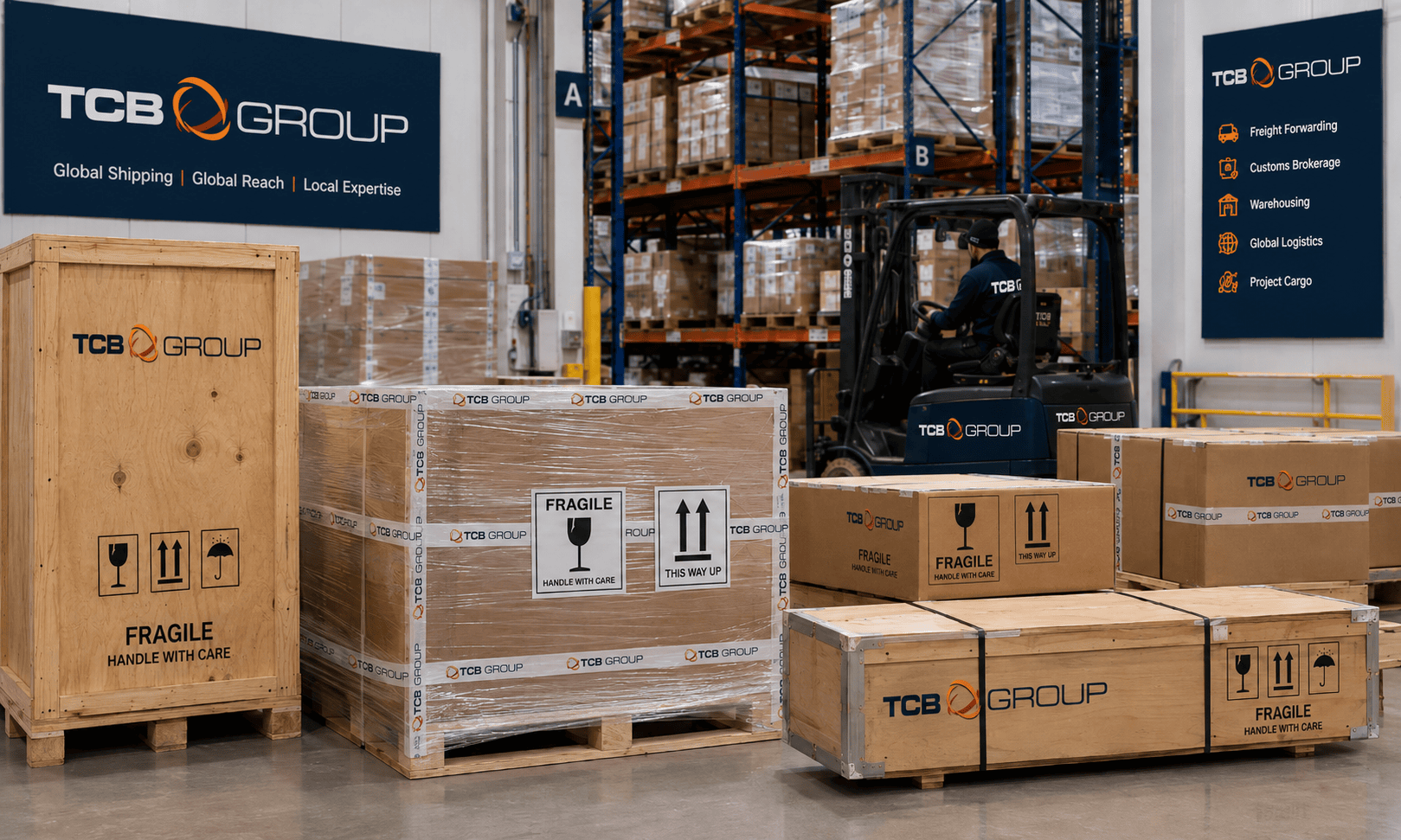
Less than container load (LCL) shipping moves pallet-sized and lower-volume sea freight in a shared container, so each shipper pays only for the space its cargo uses. This guide explains how LCL works, how it compares with a full container load (FCL), how costs are calculated and what to check before booking. TCB Group consolidates less than container load freight from the UK and Singapore to ports worldwide, and supplies LCL in Ireland through shipping agents, with a maximum three-day turnaround at our Belfast and Dublin container freight stations.
When less than container load freight is the smarter option
Less than container load shipping gives businesses a practical way to move international sea freight without paying for an entire container. By combining smaller consignments from several shippers, LCL makes ocean freight accessible for palletised, lower-volume and regularly replenished cargo.
The key is choosing the right service. Cost, frequency, routing, handling and the quality of the consolidation network all affect the outcome. A strong LCL provider offers clear schedules, dependable local partners and good control from consolidation through to final delivery.
For businesses and freight agents, the best service balances cost, reliability, transit time and visibility for the shipment, rather than simply offering the cheapest headline rate.
What is LCL shipping?
How does less than container load consolidation work?
LCL, short for less than container load, allows several shippers to share space inside one ocean freight container. Instead of booking a full container, each customer pays for the space their own cargo needs. A freight consolidator combines compatible consignments travelling on the same route, then separates them again at destination.
This makes less than container load shipping particularly useful for pallets, crates and commercial consignments that are too large for economical parcel transport but do not justify a dedicated 20-foot or 40-foot container.
What is the difference between LCL and FCL?
With FCL, one shipper books the container for its own cargo. With LCL, container space is shared. Less than container load can therefore cut the cost of unused capacity on smaller shipments, although consolidation and deconsolidation add handling stages that must be counted when comparing the total door-to-door cost.
| LCL (less than container load) | FCL (full container load) | |
|---|---|---|
| Who uses the container | Several shippers share it | One shipper books it |
| What you pay for | The space or weight your cargo uses | The whole container |
| Handling | Packed and unpacked at a CFS | Sealed at origin, opened by the receiver |
| Best suited to | Pallets, part loads, regular smaller orders | Enough cargo to fill most of a container |
| Transit | Extra time at the CFS at each end | Moves straight from port to receiver |
Related service: TCB Group freight consolidation
LCL vs FCL: when should you use each?
When is LCL the smarter option?
Less than container load shipping is often the smarter option when cargo fills only a modest share of a container. It lets businesses ship smaller quantities without waiting to build enough stock for FCL, which keeps inventory moving and reduces the capital tied up in goods.
It can also suit businesses testing a new supplier or market, bringing in regular replenishment stock or moving variable volumes. Frequent LCL services give supply chains more flexibility, because orders can move according to demand rather than container utilisation.
When might FCL be more suitable?
As shipment volume increases, the economics shift towards FCL. LCL also involves more warehouse handling, so a dedicated container may be better for very large, highly fragile or sensitive consignments. There is no universal break-even point between LCL and FCL, because rates and local charges vary by trade lane.
A good freight partner compares the full cost and operational needs of both options rather than recommending one mode automatically.
How does an LCL shipment move?
What happens at the consolidation warehouse?
The process usually starts with collection from the shipper or delivery into a container freight station, known as a CFS. Cargo is received, checked against the booking, measured where required and prepared for consolidation with other less than container load shipments on the same sailing.
Accurate dimensions, gross weight, packaging and documents are important. Differences between the booked cargo and the freight presented at the CFS can affect pricing, handling and container planning.
What happens during transport and at destination?
Once the load is built, the consignments are loaded into a shared container and moved by sea. The container may travel directly to destination or through an established consolidation hub. At destination it is devanned, individual shipments are separated, customs formalities are completed and cargo is released for collection or delivery.
Direct services and well-managed hubs generally give greater visibility than fragmented routing through several unrelated parties. For UK imports, businesses can review the official requirements in GOV.UK guidance on importing goods.
How are LCL costs calculated?
What does weight or measure mean?
Less than container load freight is commonly charged on a weight or measure basis, often written as W/M. The chargeable quantity is the greater of the cargo’s volume or its weight under the tariff rules for the trade lane, so dense and bulky shipments can produce different chargeable results.
Which charges should businesses compare?
The ocean freight rate is only one part of the total. Collection, CFS receiving, documentation, export customs, destination handling, deconsolidation, import clearance and final delivery may also apply. The exact scope depends on the route, the Incoterm and the shipment.
For a reliable comparison, provide accurate package numbers, dimensions, weight, commodity, origin, destination and Incoterm. A strong quotation shows clearly what is included and excluded, so that different providers can be compared like for like.
Why does the LCL consolidator matter?
Why are network strength and service frequency important?
Less than container load shipping depends heavily on the quality of the consolidator and its partner network. Regular departures give more booking flexibility, while strong origin and destination partners reduce delays, communication gaps and inconsistent handling.
Ask whether the service is operated in-house, how often it departs, where transhipment takes place and who controls the cargo at origin and destination. A well-established consolidation network is especially valuable when freight connects through regional hubs to less direct destinations.
Why does in-house handling improve control?
A provider with in-house CFS capability has more direct oversight of receiving, loading, devanning and cargo availability. That improves communication when cargo arrives close to cut-off, dimensions change or special handling is needed.
“The value of a good LCL service is not just the rate. Customers need to know who is handling their freight, when it is moving and what happens next.” Shane Delargy, TCB Group
Where does TCB Group run LCL services?
TCB Group consolidates less than container load freight from its own offices in the UK and Singapore, with global coverage through hubs in New York, Rotterdam, Qingdao, Colombo and Singapore.
From the UK, we run weekly direct sea freight to Singapore, with onward connections across Asia-Pacific, and pallet-sized sea and air freight worldwide, with goods received into our St Helens and Belfast CFS. From Singapore, we run multiple weekly LCL services across Asia-Pacific, weekly services to Europe and the United States, and fixed weekly sailings to Thailand, Indonesia and Vietnam. For prices, transit and how to book, see our LCL shipping page.
How does TCB Group support LCL in Ireland?
What does the CWT Globelink network add?
Since 2020, TCB Group has represented the CWT Globelink freight consolidation network in Ireland. The network gives TCB Group access to established LCL partners and international coverage, alongside our own in-house consolidation services, so Irish freight agents have dependable options across major global trade lanes.
How does TCB Group’s neutral wholesale model support Irish shipping agents?
In Ireland, TCB Group provides wholesale less than container load services to shipping agents, so they can offer reliable, competitive options to their own customers.
These services are strictly neutral. TCB Group does not work directly with the customers of its Irish shipping agent partners. Agents can use our consolidation infrastructure, schedules and international network without any conflict with their own customer relationships.
“Our mission is simple: to equip our partners with the most competitive, reliable wholesale solutions they need to secure bookings and provide an outstanding service for their customers.” Darren Green, Managing Director, TCB Group
Which weekly in-house LCL consolidations does TCB Group operate in Ireland?
TCB Group operates weekly in-house LCL consolidations, supported by direct services and hub connections that extend coverage across Asia, the Americas, Europe, Africa and Australasia.
Import consolidations:
- Qingdao hub, serving Japan and South Korea
- Xiamen, Shanghai, Ningbo and Shenzhen
- Taiwan
- Singapore hub, serving South-East Asia and Australasia
- Mumbai, serving West India and Bangalore
- Colombo hub, serving East and South India, Bangladesh and Pakistan
- New York hub, serving all US origins
Export consolidations run through the Singapore hub, with second-leg services across Asia-Pacific, and the Rotterdam hub, with second-leg services to the United States and Africa.
Learn more about TCB Group’s wholesale services and LCL export services from Dublin.
What should you check before booking LCL?
What information is needed for an LCL quote?
Provide the origin, destination, package count, package dimensions, gross weight, commodity and Incoterm. Include collection and delivery postcodes and explain any special requirements, such as dangerous goods, fragile cargo, non-stackable pallets or time-sensitive delivery.
How should LCL cargo be packed?
Less than container load cargo is handled more than a full container, so packaging should protect the goods through warehouse handling, container loading, ocean transport and devanning. Pallets should be stable, cases securely closed and fragile goods protected against movement. Labels and shipping marks should match the documents, so consignments can be identified quickly at destination.
What documents are normally required?
Each less than container load shipment usually needs a commercial invoice and packing list, together with transport and customs documents suited to the route. Commodity-specific licences, certificates or declarations may also apply. Preparing documents before arrival helps avoid customs delays.
FAQs
What does LCL mean in shipping?
LCL means less than container load. Several shippers share one ocean freight container, and each pays for the space or chargeable weight its consignment uses rather than booking the whole container.
What is the difference between LCL and FCL shipping?
In LCL shipping, several shippers share a container and each pays for its own space. In FCL shipping, one shipper books the whole container. LCL suits smaller volumes, and FCL suits cargo that fills most of a container.
When is LCL cheaper than FCL?
Less than container load is often cheaper for lower-volume cargo, because the shipper avoids paying for unused container space. As volumes increase, FCL can become more economical, because LCL also includes consolidation, handling and deconsolidation charges.
How are LCL freight charges calculated?
LCL freight is commonly priced on weight or measure, plus origin and destination charges. Collection, CFS handling, documents, customs clearance, deconsolidation and delivery all affect the final door-to-door cost.
Are LCL shipments slower than FCL?
LCL can take longer, because freight must be consolidated before departure and separated at destination. Actual transit depends on sailing frequency, routing and the number of hand-offs. Strong direct services improve predictability.